AI-Powered Site Analysis vs Manual Research: A Comparison for Architecture Firms
A practical comparison of AI-assisted site analysis and traditional manual desk research for architecture and planning teams.
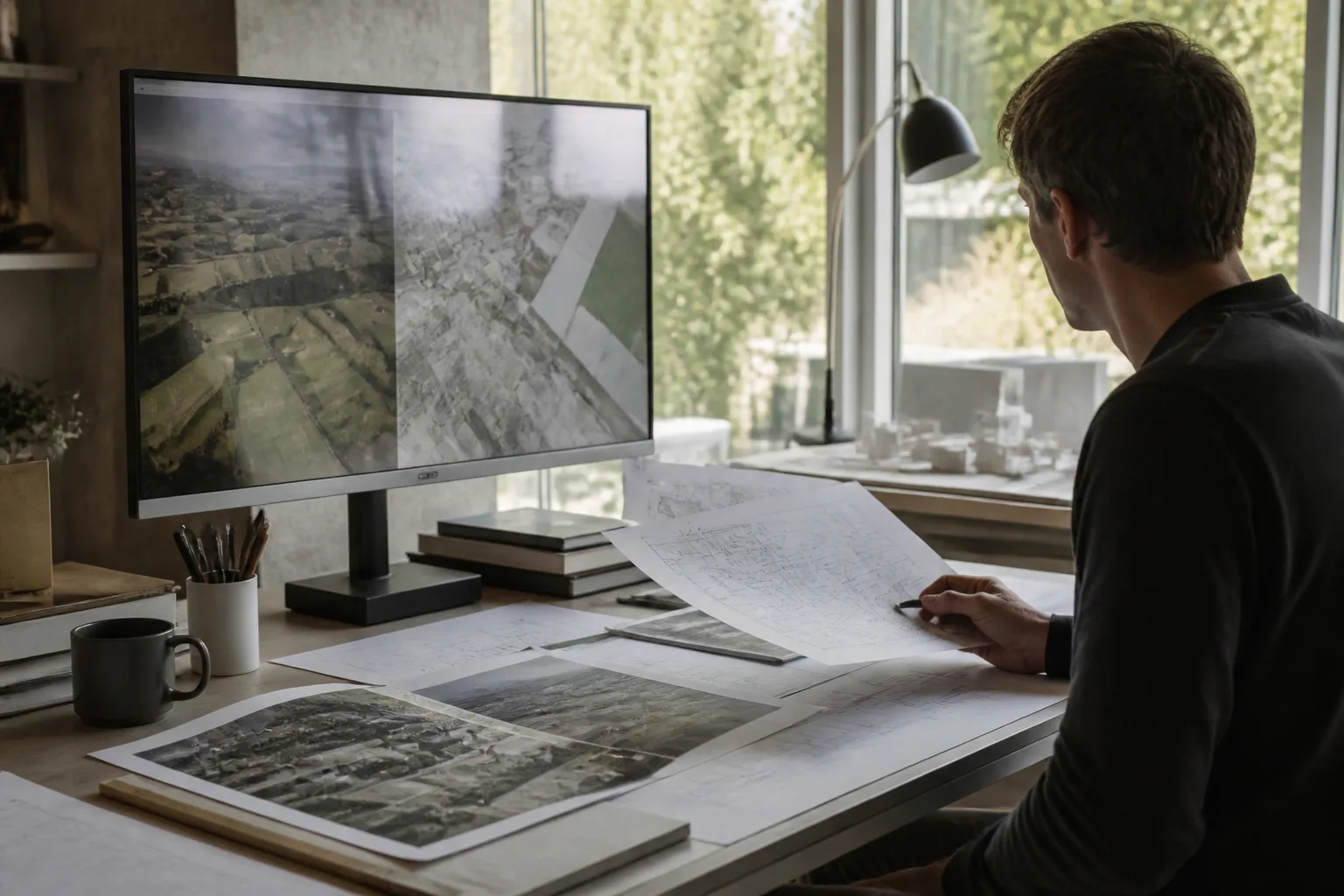
Quick answer
AI-assisted site analysis can help assemble repeatable early-stage evidence, but its value depends on source coverage, accuracy and the review effort it creates. Compare preparation, processing, correction and handover on representative sites before claiming a saving. Professional interpretation and specialist assessment remain separate responsibilities.
The real comparison is not "AI or expertise".
It is whether your most experienced people should spend their time assembling the same first-pass site evidence over and over again, or using that evidence to make better design and planning decisions.
That is the part many AI comparison articles miss. They stay philosophical. Architecture firms need an operational answer.
What does manual site research still do better?
Manual work still wins where the task depends on local judgement, nuanced interpretation, or formal accountability.
That includes:
- negotiating a planning strategy with a case officer
- interpreting edge-case heritage or townscape issues
- validating measured survey information
- signing off on specialist consultant advice
Accountable professionals need to review project-specific interpretation; experience alone does not guarantee that every issue will be found.
Where does AI create the biggest advantage for architecture firms?
A useful candidate for evaluation is repetitive evidence assembly.
Evaluate whether the workflow can:
- gather the same baseline evidence consistently for every site
- compare multiple sites using the same criteria
- produce summaries and exports the next person can use
- keep the research stack from fragmenting across browser tabs, PDFs, and screenshots
The size of any improvement needs measurement on comparable tasks. Include missing-source investigation, correction and downstream cleanup, and record whether the reviewed output supports the intended decision.
What are the failure modes of a manual workflow that firms rarely price properly?
Manual research fails in ways firms often treat as normal:
- one person misses a source because they are under time pressure
- every project is researched in a slightly different way
- the output is difficult to compare across sites
- the design team still has to rebuild geometry after the research is done
That last point is where the workflow argument becomes commercial. If the research is "complete" but the architect still has to reconstruct the site in CAD, the firm has not saved time. It has only moved the labour downstream. That is why this comparison should connect directly to pre-construction site analysis, site feasibility, and AutoCAD/Revit export.
What does a realistic hybrid workflow look like?
The best version is simple.
Use automated or AI-supported workflows for:
- site screening
- first-pass comparison
- summarising evidence
- producing shareable outputs
- routing the right data into downstream tools
Use human judgement for:
- policy strategy
- design direction
- formal sign-off
- consultant coordination
- edge cases where local knowledge really matters
That is a better model than pretending AI can replace expertise, and a better model than pretending experts should keep doing all the repetitive groundwork themselves.
Review automated failure modes too
A service can return incomplete source coverage, infer a missing value or summarise a policy incorrectly. Review material conclusions against their sources and show unresolved gaps. A consistent template is useful, but it does not make different locations equally well evidenced.
Illustrative example
Illustrative scenario: A team screens several sites using the same questions, records missing evidence separately and compares the review effort for each. Any time-saving claim would require measured preparation, generation and correction time.
Frequently asked
Does AI-powered site analysis replace architects?
No. It can help with research and formatting, while architects retain responsibility for appropriate review, design and planning judgement.
What is the biggest advantage over manual workflows?
A consistent review structure can help comparison. The actual evidence may differ by location and availability, so gaps must remain visible.
What should still be done manually?
Formal planning strategy, specialist sign-off, measured verification, and project-specific interpretation.
Why does export quality matter in this comparison?
Because conversion, review and cleanup effort affect the total benefit. Test representative files in the receiving application.
How should firms decide where AI belongs?
Map the workflow and assign automation to the repetitive evidence-gathering stage, not to the parts that rely on accountable professional judgement.
Conclusion
Use a small comparison to decide which tasks benefit from automation and which still need additional evidence or professional work. Report measured effort and output quality together rather than treating generation time as the whole result.

About the author
Shatakshi Patil
Architect writing about pre-construction due diligence, planning context, and site intelligence workflows for design teams using Atlasly.
Sources and references
Authoritative references for the planning policies, regulations, and standards referenced in this article. Always check the publisher for the latest version.
Related articles
Auto-suggested
pre-construction site analysis
Pre-Construction Site Analysis: The Complete Guide for Architects and Engineers
A comprehensive guide to zoning, flood risk, solar, topography, transport, demographics, reports, and CAD-ready outputs in pre-construction workflows.
Read
site feasibility study checklist
Site Feasibility Study Checklist: 12 Things to Assess Before Your Design Brief
A practical 12-point checklist covering planning, physical, environmental, access, and viability factors that should be tested before briefing design work.
Read
pre-construction due diligence for architects
Pre-Construction Due Diligence for Architects: An Early Review Checklist
An early due-diligence checklist for architects covering site evidence, planning questions, physical conditions, specialist investigations and unresolved project assumptions.
Read
AI site analysis vs manual research
AI Site Analysis vs Manual Research: Where Architecture Firms Actually Save Time
A practical comparison of AI site analysis versus manual research for architecture firms, covering where automation saves time and where human judgement still matters.
Read