Biodiversity Net Gain (BNG) Explained: A Practical Architects Guide for 2026
How England’s statutory biodiversity net gain regime affects site layout, ecology evidence, delivery and management, including the August 2026 exemption changes.
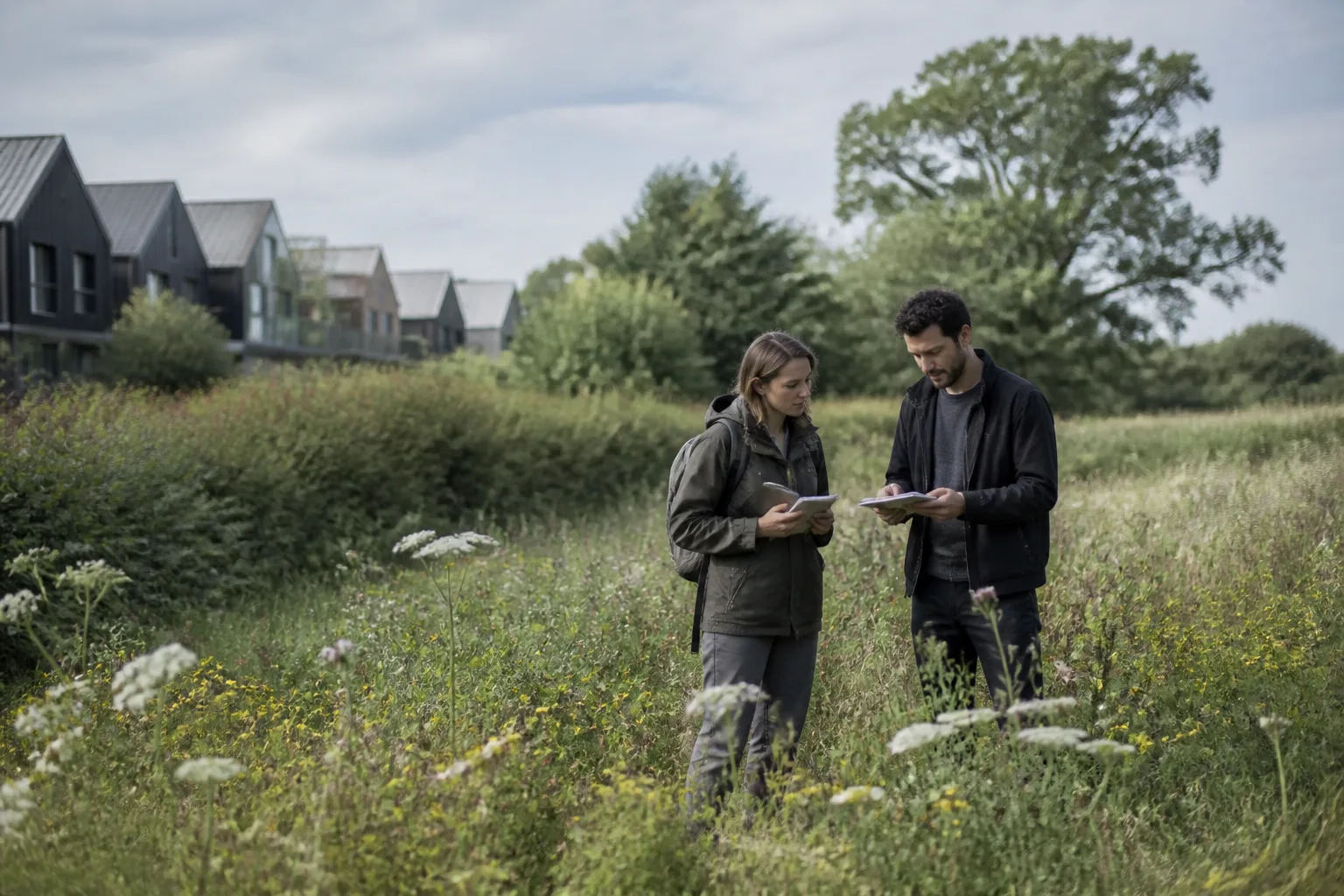
Quick answer
Biodiversity net gain is a measured improvement against a habitat baseline. England’s statutory regime generally requires at least 10% for development within scope, but exemptions and transition dates matter. Establish habitat evidence and the correct metric before relying on an early landscape or viability assumption.
The useful architectural question is not simply whether a plan contains enough green space. It is which habitats exist, what the proposal retains or changes, and whether the intended outcome can be delivered and managed. BNG can affect site layout and responsibilities long after construction.
This guide addresses England’s statutory planning regime as reviewed on 12 September 2026. Do not transfer its percentage, exemptions or approval process to another UK nation.
Start with applicability, not a universal charge
Mandatory BNG does not apply to every project. The government’s planning guidance sets the eligibility and transition rules. Applications from 6 August 2026 have a new small-site exemption at no more than 0.2 hectares, subject to no impact on onsite priority habitat. Earlier self/custom-build exemptions and section 73 cases need their own date-sensitive checks.
Keep evidence of the site area and habitat assessment used for an exemption. An exemption from the biodiversity gain condition does not answer separate questions about designated sites, protected species, ancient woodland or local policy.
How the habitat baseline affects design
A competent assessment must distinguish habitats, their extent and condition. Existing mapping can guide survey scoping but may miss recent changes or habitats beneath a broad land-use label. Ask for the survey date, methodology and any inaccessible areas. Investigate whether past habitat degradation affects the statutory baseline rather than assuming the current appearance is always sufficient.
Mark retained habitat and construction protection on the same coordinated plan as building footprints, levels, drainage, utilities and temporary works. This reveals conflicts before a preferred option becomes expensive to revise.
Understand units and delivery risks
Use the statutory metric guidance and tools, including the Small Sites Metric only where its eligibility conditions are met. Do not call the current statutory tool “Metric 4.0”. Area habitats, hedgerows and watercourses use separate unit types and trading rules. A positive total in one category cannot automatically repair a deficit in another.
A proposed woodland does not instantly have the value of an established woodland. Delivery time, difficulty and location can affect the calculation. Ancient woodland and other irreplaceable habitats need their own treatment; they cannot be treated as ordinary high-value habitat that any surplus can replace.
Choose an achievable delivery strategy
Compare habitat retention and enhancement with the realistic space needed for the project. A green roof, rain garden or planting proposal needs appropriate habitat classification and management assumptions; it is not automatically a fixed biodiversity credit. Obtain quotes for the actual delivery route rather than using an unsourced nationwide price per unit.
The August 2026 minor-development changes allow qualifying non-exempt minor schemes to consider onsite and offsite gains together. For other cases, establish the applicable hierarchy. Distinguish registered offsite gains from government statutory credits, and record who will arrange any allocation, registration and legal securing.
Separate application evidence from the gain plan
Identify the biodiversity information required with the planning application and the gain plan that normally needs approval before commencement. Do not defer habitat investigations until that condition is due: the early layout must remain capable of delivering the assumed outcome.
For significant onsite enhancements and offsite gains, establish the applicable long-term management and securing arrangements, generally at least 30 years. Agree responsibilities, access, monitoring, costs and remedies with the relevant advisers. Avoid promising that every minor landscape feature must appear in the same legal agreement.
A practical architect–ecologist handover
Issue the ecologist a boundary plan and a revision-controlled layout including temporary works and service corridors. Request a marked-up baseline, proposed habitat plan, metric file, assumptions, outstanding surveys and delivery issues.
Carry habitat decisions into specifications and maintenance information. If a retained tree, drainage feature or roof build-up changes during design, ask whether that affects the assessment. The Atlasly unit-uplift calculator can illustrate arithmetic using supplied metric units; it is not the habitat survey, statutory metric or approval process.
Illustrative example
Illustrative scenario: A team compares landscape options against a provisional habitat baseline, marks the assumptions and commissions the appropriate ecology input. A desktop calculator does not establish the statutory baseline or remove approval requirements.
Frequently asked
Is BNG required for every small site?
No. Exemptions changed on 6 August 2026. Check application date, site area, priority habitat and the other applicable conditions rather than assuming all small sites are in scope.
Can I add hedgerow units to habitat-area units?
No. Use the separate metric categories and their rules. A combined single score can hide a shortfall.
Must the entire gain plan be approved before planning permission?
Normally the biodiversity gain condition requires approval of the gain plan before commencement. Information is also required at the application stage; confirm both stages for the proposal.
Does more planted area guarantee compliance?
No. Baseline evidence, habitat type and condition, delivery risks, trading rules and the securing of gains all matter.
Conclusion
Make biodiversity decisions alongside the layout and document the evidence behind them. The useful output is a deliverable, maintainable habitat proposal with a traceable assessment, not a landscape percentage presented as automatic compliance.

About the author
Shatakshi Patil
Architect writing about pre-construction due diligence, planning context, and site intelligence workflows for design teams using Atlasly.
Sources and references
Authoritative references for the planning policies, regulations, and standards referenced in this article. Always check the publisher for the latest version.
Related articles
Auto-suggested
planning constraints UK architects
Understanding Planning Constraints Before You Design: A Guide for UK Architects
A UK-focused guide to reading planning constraints early, from conservation and flood overlays to Article 4, heritage, and policy triggers.
Read
heritage and ecology constraints development
Heritage, Ecology, and Biodiversity Constraints: What Architects Must Check Before Designing
An England-focused workflow for heritage and ecology evidence: consent triggers, setting, survey scope, protected species and biodiversity gain, with official sources.
Read
pre-construction site analysis
Pre-Construction Site Analysis: The Complete Guide for Architects and Engineers
A comprehensive guide to zoning, flood risk, solar, topography, transport, demographics, reports, and CAD-ready outputs in pre-construction workflows.
Read
Planning
Biodiversity Net Gain 2026: Architect's Guide + Free BNG Calculator
An England-focused guide to statutory biodiversity net gain, August 2026 exemptions and using a unit-uplift calculator without confusing arithmetic with compliance.
Read