Heritage, Ecology, and Biodiversity Constraints: What Architects Must Check Before Designing
An England-focused workflow for heritage and ecology evidence: consent triggers, setting, survey scope, protected species and biodiversity gain, with official sources.
Quick answer
Check the designation records, site history and habitat evidence before fixing a layout. In England, listed building consent depends on the works and their effect on special interest; heritage setting and ecology require proportionate assessment. Species survey timing depends on the species and survey type. A map or desktop report does not establish complete coverage or consent.
Heritage and ecology findings can change a design brief, but they do not all imply automatic refusal. The useful early task is to identify what is known, which legal or policy tests may apply and what investigation is needed while options remain open.
This guide covers England, with sources reviewed on 12 September 2026. Combine national designations with local records, site inspection and appropriate specialist advice. Absence from a broad dataset is not evidence that a heritage asset or protected species is absent.
Heritage: distinguish assets, setting and consents
Listed building consent is needed for demolition and alterations or extensions affecting a listed building’s character as a building of special architectural or historic interest. It can include internal work. A mapped list point does not settle the extent of listing or curtilage. Review the entry, history and actual building.
Setting is relevant to significance and planning assessment, but “any harm means automatic refusal” is not a correct summary. Likewise, conservation-area status does not prohibit all change. Relevant demolition in English conservation areas is generally dealt with through planning permission, rather than a separate conservation-area consent application.
Other heritage evidence to obtain
Check scheduled-monument records and the relevant consent route before proposing works affecting a monument. Do not assume every adjacent scheme must prove no harm or that most consent applications are refused; the statutory and policy assessment depends on the proposal.
Registered parks and gardens, local heritage lists and the Historic Environment Record may be relevant even without a listed building on site. Consultation requirements vary with the asset and proposal. The Historic England consents guidance explains the separate routes. Request archaeological evaluation where the evidence and authority’s requirements justify it, rather than prescribing excavation for every site.
Ecology: scope the survey to likely effects
Protected-species evidence depends on habitat suitability, records and the effects of the proposed work. The government survey guidance distinguishes species and survey purposes: a preliminary bat-roost assessment can take place year-round, while summer-roost, hibernation and activity surveys have different windows. Great crested newt conventional and eDNA survey windows also differ.
Ask the ecologist for the survey method, season, weather conditions, number of visits and any licensing needs. It is incorrect to say all bat surveys can only occur May–September, or that every nearby species record automatically requires a mitigation agreement with Natural England. A protected-species licence, when required, is separate from planning permission.
Designated habitats and ancient trees
For SSSIs, distinguish the planning consultation process from the consent or assent procedure applying to the person or public body carrying out an operation. Identify likely effects and the correct route with the relevant adviser; do not promise approval or near-certain refusal from proximity alone.
Ancient woodland standing advice recommends at least 15 metres of buffer from woodland, with more where assessed impacts extend further. Ancient and veteran trees have a different size-based recommendation. These are not universal legal-distance tests. Survey and assess the habitat and construction effects, including access, lighting, drainage and temporary works.
BNG is a separate, date-sensitive check
England’s statutory BNG regime has exemptions and transition rules. The current exemption guidance includes changes from 6 August 2026; do not assume every project must deliver the same metric and management package. Exemption does not remove other ecology duties.
For an in-scope scheme, obtain the correct baseline and metric assessment, distinguish the information needed with the application from the gain plan normally approved before commencement, and agree how relevant gains will be secured and maintained. See the BNG guide.
Turn the findings into coordinated design decisions
Prepare an evidence plan showing the source records, areas needing verification and relationships that may affect the scheme. Pair each issue with an action: confirm curtilage, assess a view, commission a survey, change a lighting proposal or preserve a habitat corridor.
Keep a programme for seasonal work and consultation, with named owners and dependencies. Atlasly can help organise available context, but it does not guarantee detection of every local record, species or consent trigger. The design team should retain the underlying evidence and commission proportionate investigations before relying on a conclusion.
Illustrative example
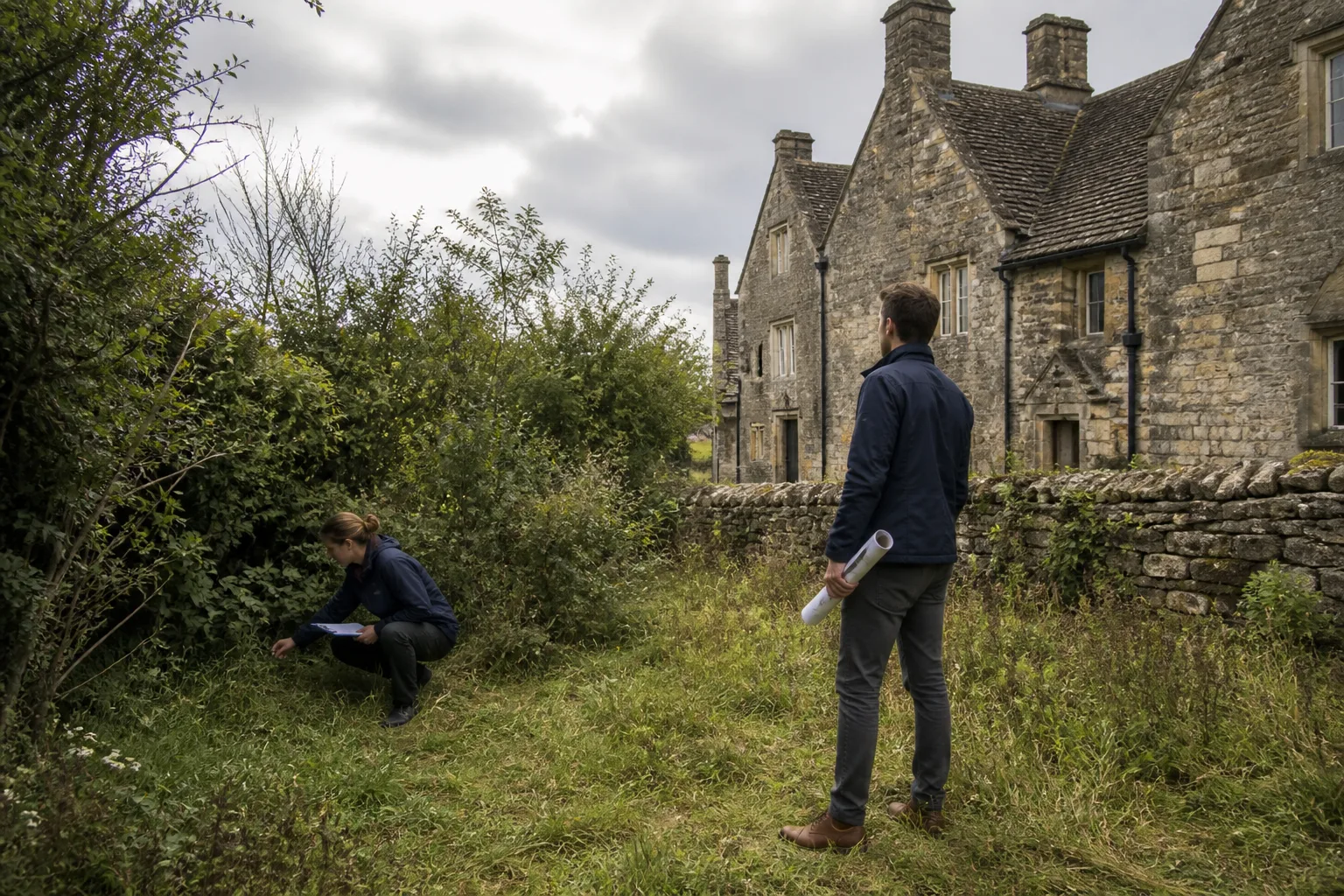
Illustrative scenario: A site review identifies a nearby environmental designation. The team checks the original record and seeks specialist advice on possible effects before changing the layout; proximity alone does not determine the response.
Frequently asked
Does any work to a listed building need consent?
The legal trigger concerns demolition and alteration or extension affecting the building’s special-interest character. Some work may not trigger consent; establish the scope with appropriate advice.
Are all bat surveys summer-only?
No. Timing depends on the survey purpose and species. Preliminary roost, summer roost, hibernation and activity surveys have different requirements.
Does a 15-metre buffer settle ancient woodland impacts?
No. It is a minimum standing-advice recommendation, and larger buffers may be needed for assessed impacts.
Does no mapped ecology record mean no constraint?
No. National and local records can be incomplete, and surveys may identify relevant habitats or species.
Conclusion
Use heritage and ecology evidence to shape options while choices remain open. Keep the designation, legal route, assessment and design response distinct, and make missing information visible in the project programme.

About the author
Shatakshi Patil
Architect writing about pre-construction due diligence, planning context, and site intelligence workflows for design teams using Atlasly.
Sources and references
Authoritative references for the planning policies, regulations, and standards referenced in this article. Always check the publisher for the latest version.
Related articles
Auto-suggested
planning constraints UK architects
Understanding Planning Constraints Before You Design: A Guide for UK Architects
A UK-focused guide to reading planning constraints early, from conservation and flood overlays to Article 4, heritage, and policy triggers.
Read
site feasibility study checklist
Site Feasibility Study Checklist: 12 Things to Assess Before Your Design Brief
A practical 12-point checklist covering planning, physical, environmental, access, and viability factors that should be tested before briefing design work.
Read
planning compliance checker UK
Planning Readiness Checks: Reviewing Site Evidence Against Current Policy
How to organise England planning evidence, verify current policies and distinguish a desktop finding from a compliance conclusion or planning decision.
Read
development feasibility analysis
Development Feasibility Analysis: FAR, Buildable Area, and Financial Viability for Architects
How architects can use FAR calculations, buildable area analysis, and early-stage financial viability screening to test development feasibility before committing design time.
Read