Site Due Diligence: 30 Questions Every Developer Should Answer Before Exchange
A working developer checklist of 30 site due diligence questions covering planning, environmental, legal, physical, and market risks before exchange of contracts.
Quick answer
Site due diligence tests planning, environmental, legal, physical and market assumptions before a capital commitment. These 30 questions provide a starting structure, not a complete search or a guarantee that the deal is safe. Commission the investigations needed for the actual site and decision.
Before relying on a site appraisal, identify the assumptions that could change the purchase, design or delivery strategy. The checklist below helps organise that enquiry. Its order should be adapted to the site and the information already available.
The previous claim that these questions covered 90% of deal-ending surprises had no supporting study and has been removed. Treat the list as a working framework and keep additional site-specific questions visible.
Planning (questions 1 to 8)
- What is the allocation in the adopted local plan?
- What is the relevant planning history, including older permissions and restrictions that may still matter?
- Are there any extant planning permissions and what are their conditions?
- Is there an Article 4 direction over any PDR class?
- Is the site in a conservation area, AONB, or National Park?
- Are there listed buildings on the site or within the immediate setting?
- What is the relevant LPA Officer view on the indicative scheme (informal pre-app)?
- What CIL and Section 106 exposure should be modelled into the appraisal?
Environmental and physical (questions 9 to 16)
- What flood zone is the site in (1, 2, 3a, 3b)?
- Is there a surface water flood risk on the actual parcel?
- What do historic uses, environmental records and a proportionate contamination assessment show? Absence from a register does not prove clean ground.
- Are there any TPOs (Tree Preservation Orders) on or adjacent to the site?
- Which habitat or species surveys and BNG eligibility checks are needed for this proposal and application date?
- What is the slope profile and likely retaining cost?
- Are there any underground utilities, easements, or oversail rights?
- What is the ground conditions risk (made ground, mining, alluvium, peat)?
Legal and title (questions 17 to 22)
- Is the title freehold or leasehold? If leasehold, what are the terms?
- Are there any restrictive covenants on the title?
- Are there overage clauses, clawback, or option agreements affecting future value?
- Are there any rights of way, prescriptive or formal, across the site?
- Does the proposed work trigger Party Wall Act notices, and is the statutory dispute-resolution process needed?
- Are there any rights to light claims from neighbouring properties?
Market and delivery (questions 23 to 30)
- What are the achievable sales values per sqm in the immediate market?
- What is the absorption rate for the indicative product mix?
- What is the realistic build cost benchmark for this typology in this market?
- What are the BCIS or local QS comparables for similar schemes?
- What is the realistic planning timeline (months from purchase to permission)?
- What is the construction programme (months from start to PC)?
- What is the exit strategy (sale, refinance, hold)?
- What is the breakeven margin if any major risk above hits?
Use the checklist with the correct legal and evidence scope
The planning examples focus on England; title and Party Wall Act references below concern England and Wales. Confirm the framework elsewhere. A title plan normally shows general boundaries, not the exact legal line: see HM Land Registry guidance. Ask the solicitor to investigate title, rights and restrictions and resolve material discrepancies with survey evidence.
The Party Wall Act booklet distinguishes notices, consent and dispute resolution. An award is not automatic for every relevant operation. Separately, check the current BNG exemptions and survey requirements; neither mapped habitat nor a ten-year search limit establishes a complete legal review.
Record an owner, evidence source, date, consequence and next action for each of the 30 questions. A seller’s pack is an input to be checked, not a substitute for the buyer’s scoped investigation.
Illustrative example
Illustrative scenario: A desktop review identifies a former potentially contaminative use. The team records the evidence and commissions the appropriate investigation before treating a remediation allowance as a reliable project cost.
Frequently asked
When should due diligence start?
Before any non-refundable money is committed. The most expensive due diligence finding is the one made after exchange.
How long does proper due diligence take?
Programme depends on the legal enquiries, source availability, site access, seasonal surveys and specialist work required. Obtain a scoped programme; a generic two-to-four-week promise is not dependable.
Who pays for due diligence?
Costs and reliance arrangements should be agreed in the transaction. Check the scope, provenance and permitted reliance of any seller-provided reports.
Is site due diligence different from a site survey?
Yes. Surveys (topographic, structural, MEP, ecological) are inputs into due diligence. Due diligence is the broader exercise of testing the deal as a whole.
Conclusion
Use the questions to build a dated risk and action record. Atlasly can help organise available desktop evidence, but it does not answer half of every legal and technical checklist automatically or replace the appointed advisers. To keep the answers with the site, record each one as a finding against its source document in Atlasly Developments.

About the author
Shatakshi Patil
Architect writing about pre-construction due diligence, planning context, and site intelligence workflows for design teams using Atlasly.
Sources and references
Authoritative references for the planning policies, regulations, and standards referenced in this article. Always check the publisher for the latest version.
Related articles
Auto-suggested
site feasibility study checklist
Site Feasibility Study Checklist: 12 Things to Assess Before Your Design Brief
A practical 12-point checklist covering planning, physical, environmental, access, and viability factors that should be tested before briefing design work.
Read
pre-construction due diligence for architects
Pre-Construction Due Diligence for Architects: An Early Review Checklist
An early due-diligence checklist for architects covering site evidence, planning questions, physical conditions, specialist investigations and unresolved project assumptions.
Read
planning constraints UK architects
Understanding Planning Constraints Before You Design: A Guide for UK Architects
A UK-focused guide to reading planning constraints early, from conservation and flood overlays to Article 4, heritage, and policy triggers.
Read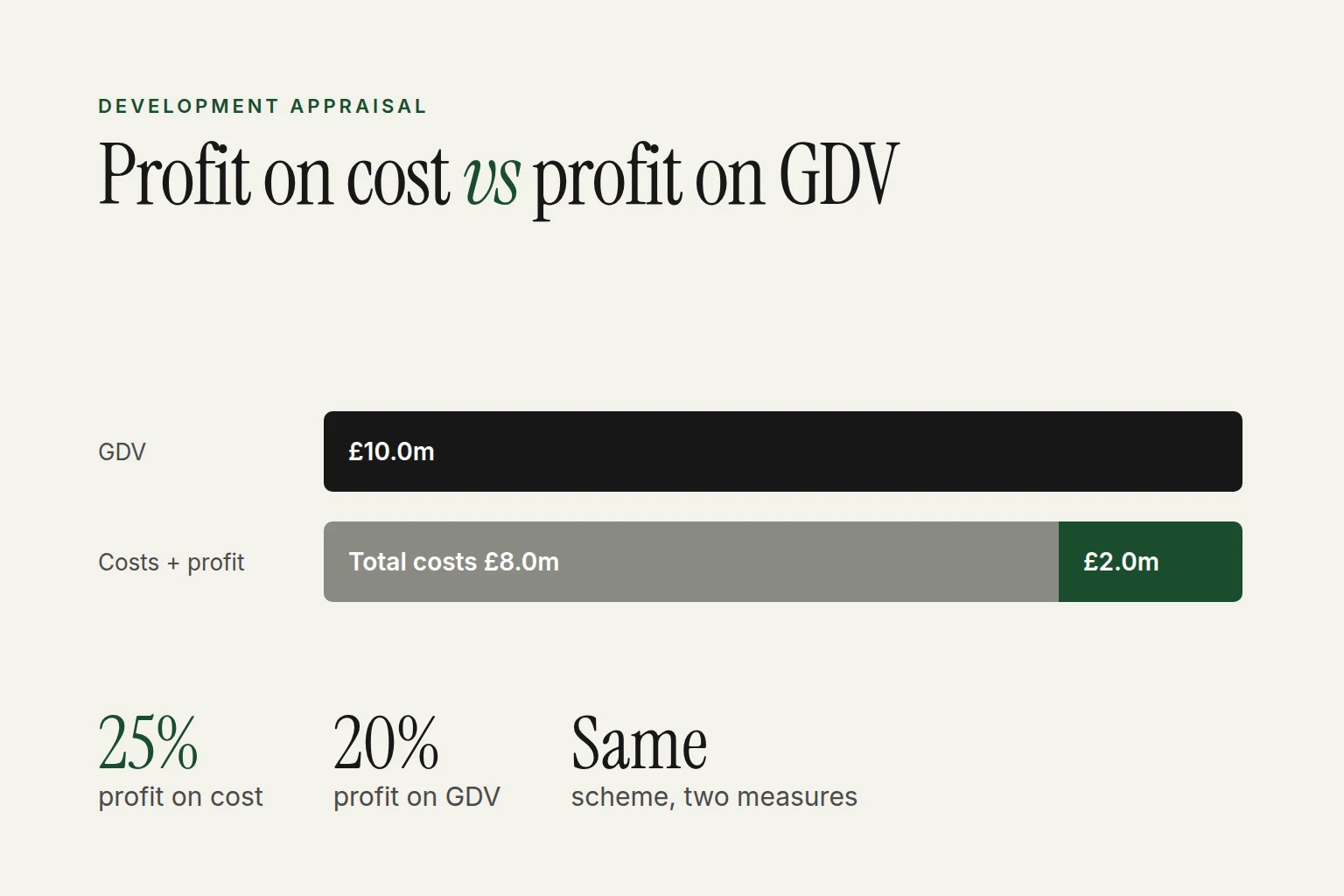
Development
What Is a Development Appraisal? Profit on Cost, Profit on GDV and Residual Land Value
A plain guide to development appraisals for property and real estate developers: the two forms, profit on cost versus profit on GDV, how an appraisal differs from a valuation, and how to test it.
Read