Tree Preservation Orders (TPOs): What Architects Need to Check Before Designing
How to check English TPOs, conservation-area tree notices and arboricultural evidence before fixing a site layout, without confusing survey categories with legal permissions.
Quick answer
In England, check the actual Tree Preservation Order and conservation-area status before proposing tree work. A survey category is not consent to remove a tree. Dying or diseased trees are not automatically exempt. Confirm applicable consent or notice requirements and use an arboriculturist to assess tree condition, root protection and construction effects.
A tree can affect layout, excavation, service routes, temporary access and future maintenance. Start the arboricultural review alongside the boundary and levels survey, before an option relies on removing a tree or working close to its roots.
This guide covers England’s TPO and conservation-area framework, checked on 12 September 2026. The operative order, its plan and current local records are essential evidence; a missing symbol on a general map does not establish an absence of protection.
Read the order, not just a map marker
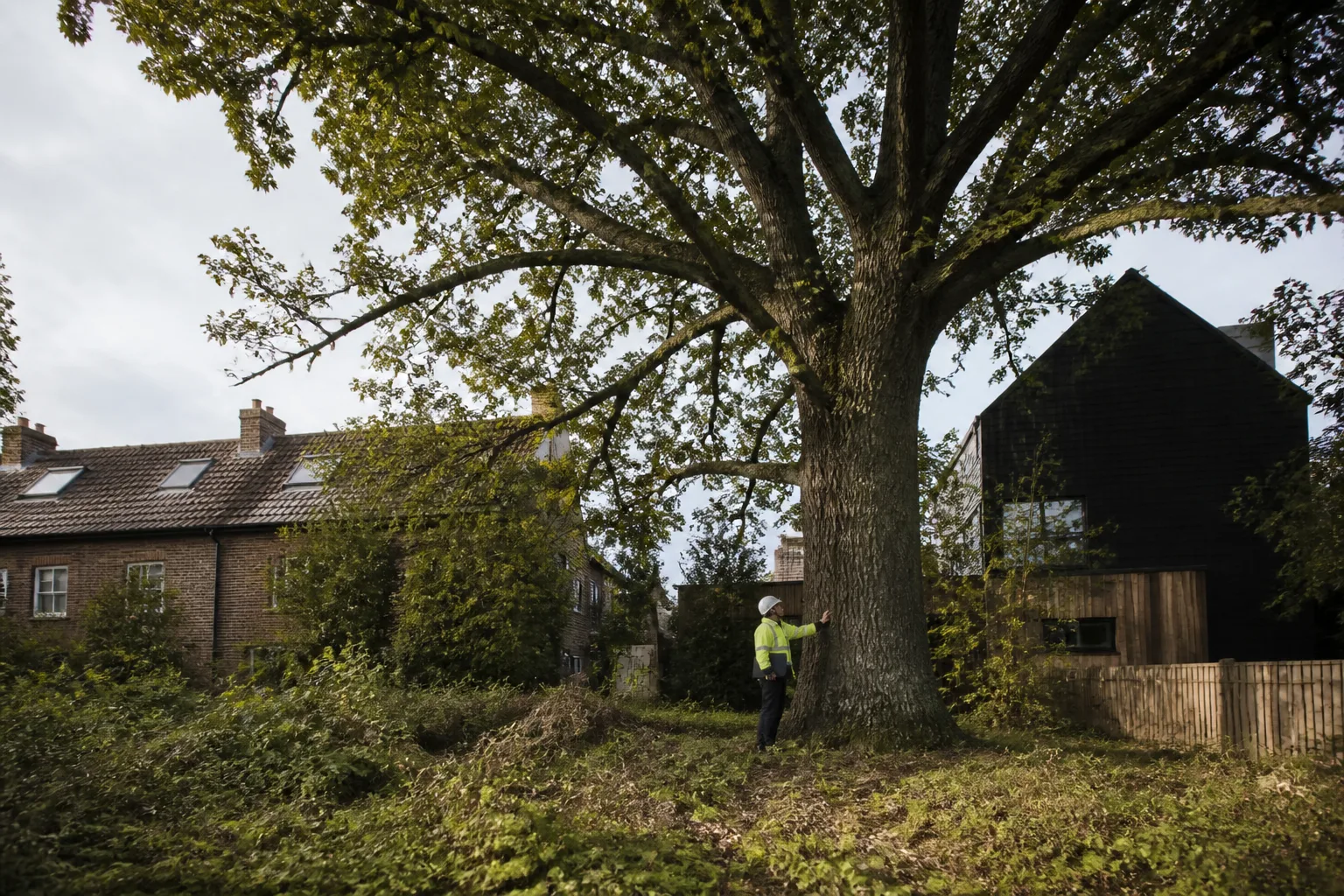
Obtain the TPO schedule and plan and check whether it protects an individual tree, group, area or woodland. Identify the relevant trees on the survey and resolve discrepancies with the authority. Group and woodland protection can be misunderstood if the review relies only on individual point records.
Record the order reference, confirmation status, source date and proposed works. A landowner’s recollection or an arboricultural category is not a substitute for the operative record.
Consent, notices and the dead-tree exception
The government TPO guidance distinguishes consent from exceptions. A diseased or dying tree still needs consent unless another exception applies. For work on a dead tree, normally give at least five working days’ written notice; urgently necessary work addressing an immediate risk of serious harm has different notification requirements. Keep evidence supporting any exception.
Trees in conservation areas can require six weeks’ notice even without a TPO, subject to exceptions including specified small-stem cases. Check the measurement and purpose of the work before relying on an exception. Unauthorised work may lead to prosecution and replacement duties; there is no single £20,000 cap applying to all tree offences.
Commission a survey that can inform the layout
Ask the arboriculturist to record species, dimensions, condition, retention categories and the design implications using the applicable BS 5837 approach. Request an assessment of neighbouring trees affected by the works as well as those inside the ownership boundary.
Categories A, B, C and U communicate arboricultural assessment; they do not mean that every A tree is legally immovable or that a C or U tree can be removed without checking protection, habitat value and consent. Consider the reasons for retention and removal within the planning strategy.
Root protection requires interpretation
A root protection area is a design and construction safeguard informed by tree measurements and the arboricultural method. The simple single-stem calculation is not sufficient for every tree. Multi-stem trees, existing structures, rooting conditions and the distribution of roots can change the assessment.
Have the arboriculturist mark the relevant area and explain any adjustment. Do not treat a circular desktop buffer as a measured root survey or an automatic no-build rule. Foundations, drainage, utility trenches, level changes, storage and construction traffic must all be assessed, not just the finished building footprint.
Coordinate protection through construction
Carry agreed retained trees, protective fencing and working restrictions into the coordinated drawings, specification and site setup. Check whether the proposed build sequence can actually respect those areas. Resolve conflicts with temporary access and deliveries before tender.
Keep the consent conditions and any arboricultural method statement with the site information. Reassess changes rather than allowing an early diagram to drift away from the construction plan. Costs and response times should be obtained for the specific instruction and application; an unsourced fixed survey price or assumed five-day council decision is not a dependable programme.
Illustrative example
Illustrative scenario: A team checks the authority record and seeks arboricultural advice before locating development near trees. A mapped point alone does not establish the tree protection area or a permissible building line.
Frequently asked
Can a dying protected tree be removed without consent?
Not merely because it is dying. Check whether another exception applies, including any immediate risk of serious harm, and follow the relevant notice requirements.
Does every conservation-area tree need six weeks’ notice?
The general notice regime has exceptions. Check stem dimensions, the work proposed and whether a TPO also applies with the authority.
Can a Category C tree be removed automatically?
No. The survey category does not override protection, planning conditions or other legal and ecological considerations.
Is a root protection circle a statutory boundary?
No. It is an arboricultural design tool requiring professional interpretation. The TPO’s scope and any consent conditions are separate.
Conclusion
Verify tree protection, obtain a survey suited to the proposed works and keep tree decisions coordinated with the construction strategy. Record unresolved legal or physical assumptions before committing to a layout.

About the author
Shatakshi Patil
Architect writing about pre-construction due diligence, planning context, and site intelligence workflows for design teams using Atlasly.
Sources and references
Authoritative references for the planning policies, regulations, and standards referenced in this article. Always check the publisher for the latest version.
Related articles
Auto-suggested
Planning
Biodiversity Net Gain (BNG) Explained: A Practical Architects Guide for 2026
How England’s statutory biodiversity net gain regime affects site layout, ecology evidence, delivery and management, including the August 2026 exemption changes.
Read
planning constraints UK architects
Understanding Planning Constraints Before You Design: A Guide for UK Architects
A UK-focused guide to reading planning constraints early, from conservation and flood overlays to Article 4, heritage, and policy triggers.
Read
site feasibility study checklist
Site Feasibility Study Checklist: 12 Things to Assess Before Your Design Brief
A practical 12-point checklist covering planning, physical, environmental, access, and viability factors that should be tested before briefing design work.
Read
Planning
Which Planning Reports Will Your Site Need? A Constraints-Led Checklist
The supporting documents a UK planning application needs are decided by the site, not by the scheme. This works backwards from the constraints on a site to the assessments a validation checklist will ask for, and shows how to settle the list before you quote a fee.
Read